The ‘Safeonweb’ model put to the test by AI: Anatomy of a Belgian cybernetic paradox
Whilst the global landscape of cybercrime has undergone a radical transformation driven by generative artificial intelligence, Belgium’s statistics on citizen engagement stand out as exceptional in Europe. Nearly half the population say they actively contribute to the country’s digital safety watch. But behind the glamour of these macro-level figures lies a more nuanced reality: the relative failure of direct application tools and a more targeted financial investment.
The invisible infrastructure: the efficiency of state-led ‘crowdsourcing’
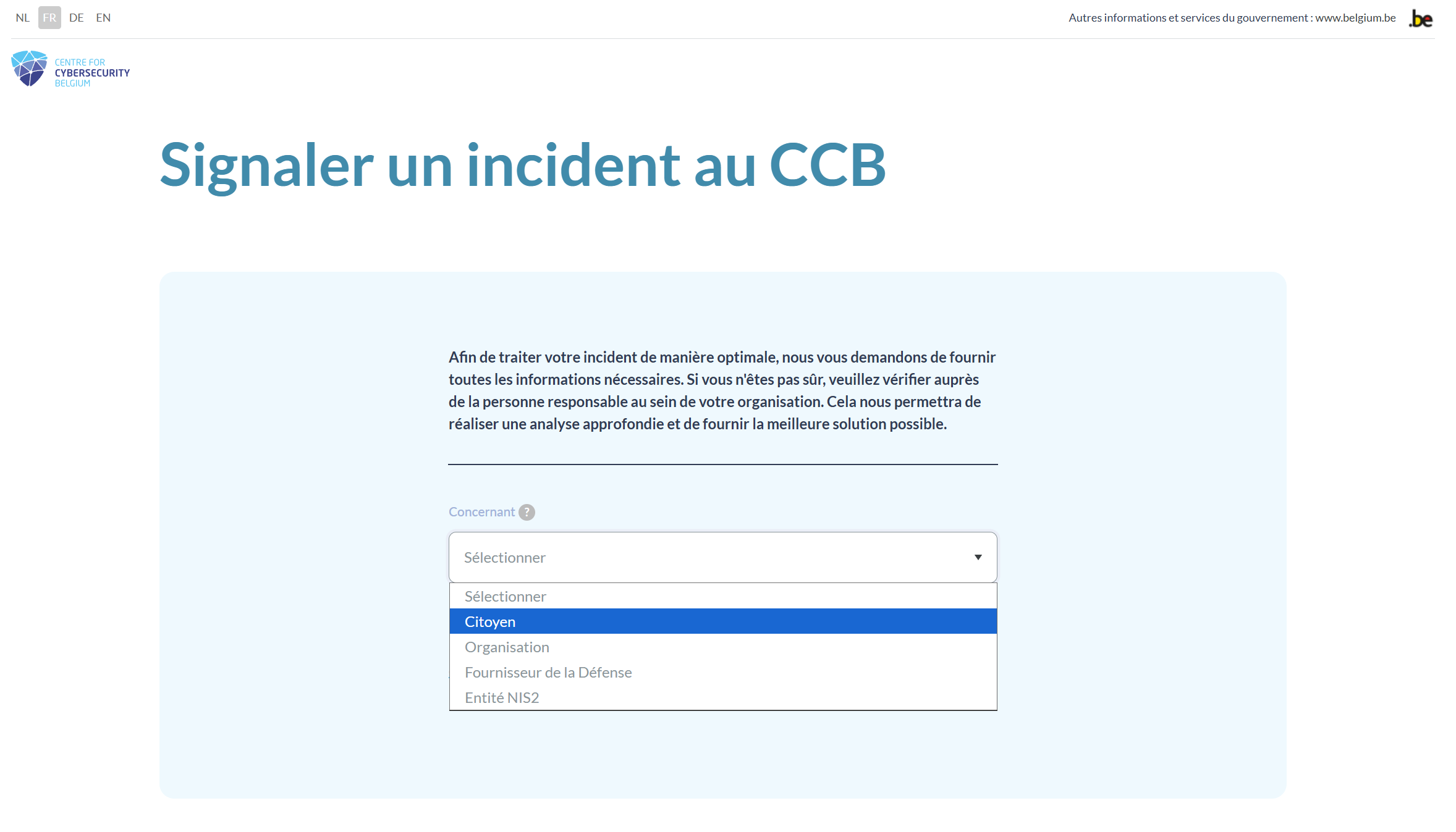
To gauge the success of the Safeonweb.be platform, run by the Belgian Centre for Cybersecurity (CCB), it is important to look beyond the traditional website and focus on its reporting architecture. The generic address
According to large-scale perception surveys carried out by the CCB in 2025/2026 amongst representative samples of the population, 44 per cent of Belgians say they have made a habit of forwarding suspicious emails and text messages to this single address. Amongst the online population, this adoption rate is exceptional for a government initiative.
This is the principle of the virtuous circle: the actions of the 44 per cent of vigilant citizens passively protect the entire national ecosystem, including the least tech-savvy users.
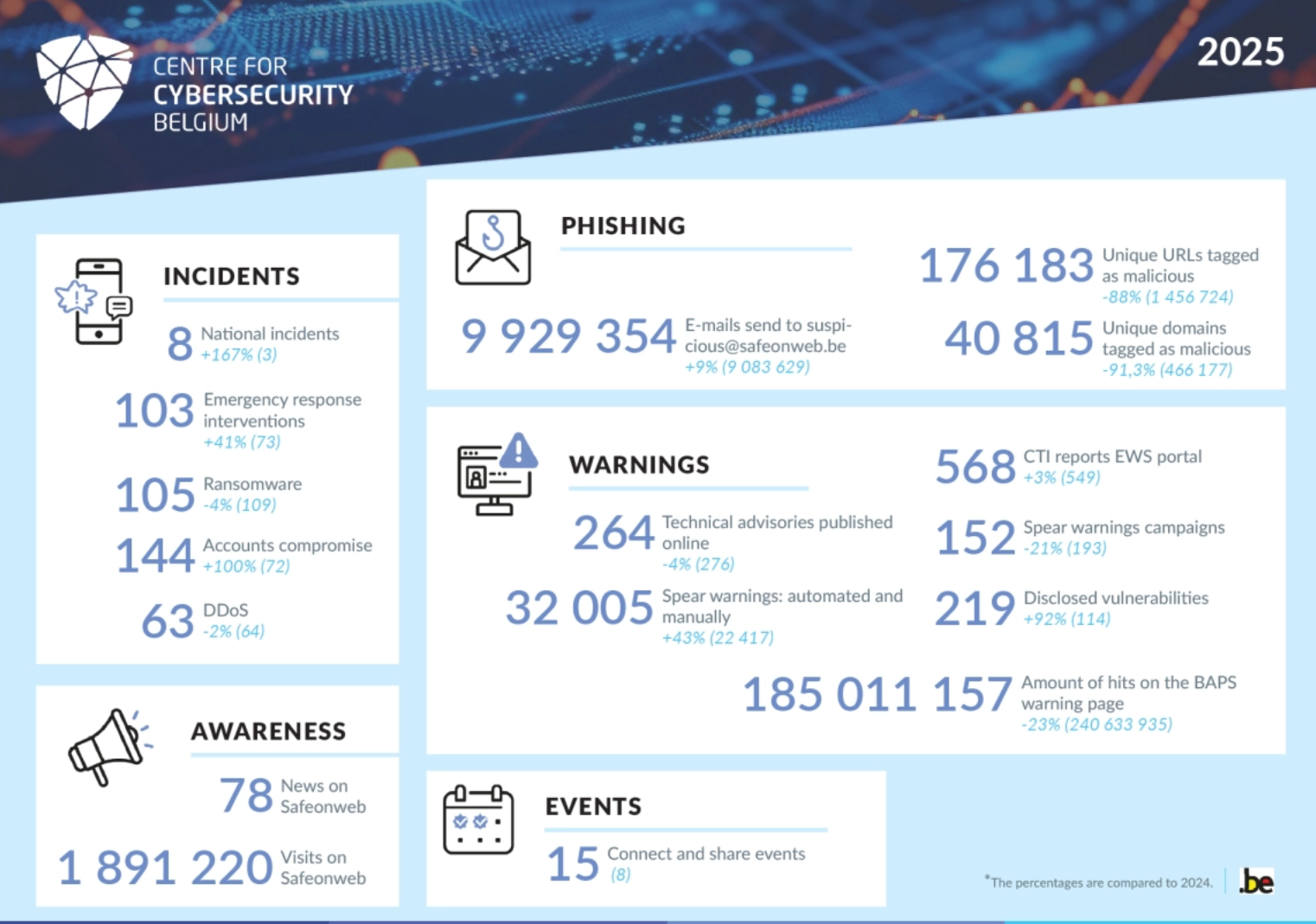
Source : https://ccb.belgium.be/news/key-figures-2025
This massive uptake results in a tremendous amount of digital background noise: the system processes between 9 and 10 million suspicious messages a year, representing a consistently high average of 25,000 to 27,000 reports per day. Processing this critical mass of information does not rely on an army of human analysts, but on an automated indexing engine. When a URL (website address) is repeatedly identified in reports from members of the public, it is extracted, classified and fed in real time into the Belgian Anti-Phishing Shield (BAPS).
This technical shield blocks access to malicious servers or redirects unaware internet users to a warning page. The activity report reveals that the system blocked more than 200 million attempts to connect to fraudulent websites during 2025.
The tipping point: the era of AI-powered social engineering
The widespread emergence of large language models (LLMs) and voice cloning tools has marked a historic turning point. Statistics from Safeonweb highlight a radical transformation in the nature of the threat, characterised by three major phenomena:
The demise of ‘old-school phishing’
accurately mimicking local administrative jargon
The traditional tell-tale signs that used to enable internet users to spot a scam — namely, clumsy syntax, glaring spelling mistakes or unusual phrasing — have been completely eliminated by AI. Phishing scams impersonating public services (SPF Finances, My eBox, bpost) or banking institutions are written in flawless French and Dutch...
The rise of vishing and high-value fraud
Whilst the volume of emails is stabilising, the financial loss per victim is skyrocketing.
Social engineering techniques now combine text messages and AI-enhanced phone calls (involving the cloning of numbers and voices), impersonating fake Card Stop agents or bank advisers. In the first half of the year alone, financial investment fraud cost Belgian citizens €15 million, with an astronomical average loss of over €37,000 per victim, as recorded by the Federal Public Service for the Economy.
The URL saturation war
AI enables cybercriminals to generate variations of malicious web addresses on the fly (domain spoofing).
This explains the sharp rise from 6 million reports received by Safeonweb in 2022 to a record high of 10 million messages. Faced with this algorithmic proliferation, the CCB had to automate its response by linking the BAPS to the databases of other regulators, such as the FSMA (for fake investment platforms) and the FPS Economy.
The audience paradox: the general public versus the technical niche
A thorough examination of the data reveals an apparent statistical anomaly: how can a public awareness figure of 44 per cent be reconciled with the fact that the Safeonweb mobile app and browser extension have recorded barely 60,000 downloads of the mobile app?
This gap can be explained by the very nature of internet usage and digital usability. The Safeonweb mobile app lacks direct utility for internet users: it serves primarily as a channel for disseminating top-down alerts (around 80 per year). For technical users, such as system administrators or savvy internet users, these alerts often arrive too late, as the browsers’ built-in filters or corporate security solutions will already have blocked the threat.
By contrast, the email address
European comparison: audience performance and budget efficiency
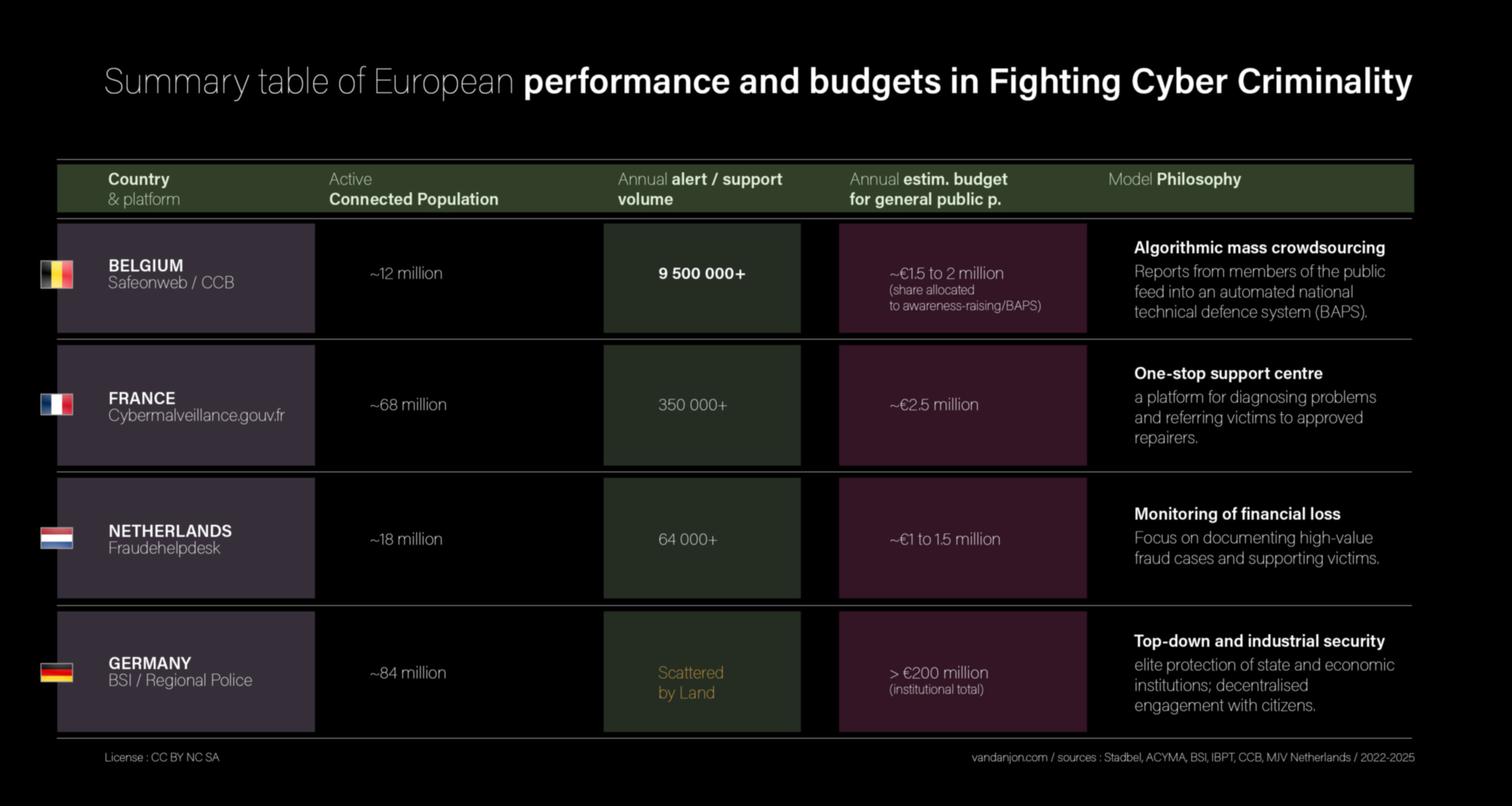
To assess the relevance of the Belgian model, it is necessary to compare it with initiatives in its immediate neighbouring countries: France, the Netherlands and Germany. A cross-analysis of the volumes of reports and the operating budgets of these organisations reveals a unique level of budgetary efficiency in Belgium.

France
Cybermalveillance.gouv.fr (ACYMA)
France has opted for a public interest group (ACYMA) with an annual budget of around 2.5 million euros (supplemented by one-off grants such as the 17Cyber project). The French model excels at post-attack assessment and connecting victims (individuals and SMEs) with local service providers.
However, strictly in terms of upstream phishing reporting, the landscape is more fragmented between the Ministry of the Interior’s Pharos platform and Signal-Spam, which dilutes the volume of direct public contributions (around 300,000 to 400,000 requests for assistance annually).

Netherlands
Fraud Helpdesk
In the Netherlands, the main point of contact for the general public is a private foundation, albeit one subsidised by the Ministry of Justice and Security (JenV).
Operating on a more limited budget and subject to structural reviews, the Fraudehelpdesk adopts a qualitative approach. It receives only 63,000 to 65,000 formal reports per year, as each entry represents a documented case of financial fraud for the purposes of legal and financial assistance – a far cry from the automated, mass processing of ‘background noise’ carried out in Belgium.

Germany
The BSI (Federal Office for Information Security)
Germany has a major institutional player in the form of the BSI, whose overall budget exceeds 200 million euros.
Whilst the BSI is a global leader in securing critical infrastructure (KRITIS) and the industrial sector (Mittelstand), its federal structure makes it difficult for the average citizen to access its services. Reports of local cybercrime are fragmented across the police forces of the various federal states (Landeskriminalamt), preventing the emergence of a single, unified community response comparable to the Belgian model.
Note: The budget comparison below focuses specifically on the section relating to the general public and public awareness campaigns, and not on these countries’ overall cybersecurity budgets.
Conclusion: An institutional ‘must-have’, an individual reflex
At the conclusion of this investigation, the answer to the question of whether Safeonweb is useful is self-evident. If one judges the platform by its mobile apps or its showcase website, it is merely an optional information tool aimed at a specific audience.
On the other hand, if Safeonweb is viewed as a hub for managing and addressing digital threats, it stands out as an absolute ‘must-have’ for Belgian local authorities. In an era where artificial intelligence enables attackers to create traps undetectable to the naked eye, Safeonweb’s centralised data system represents the only viable asymmetric response to overwhelm and block cybercriminals’ infrastructure before they strike.
With a budget proportionally smaller than that of its neighbours,
Belgium has managed to capitalise on its critical mass to unify its key players
(banks, telecoms, federal government) and transform the population into a vast army of active watchers.
Sources and References
| Belgian Centre for Cybersecurity (CCB) | Annual Report and Statistical Overviews of the Safeonweb platform, Consolidated data on the volume of reports and the operation of the Belgian Anti-Phishing Shield (BAPS). |
Source |
| Statbel (Belgian Statistical Office) | Population structure and indicators of information and communication technology (ICT) usage in Belgium. |
Source |
| ACYMA Public Interest Group | Institutional Activity Report of the Cybermalveillance.gouv.fr platform, Analysis of operating budgets (2.5 million euros) and statistics from the 17Cyber online helpline. |
Source |
| Ministerie van Justitie en Veiligheid (Netherlands) | Fraudehelpdesk Evaluation Report - Contribution to the prevention and combating of horizontal fraud, Official publication of budget data and the volume of reported scams. |
Source |
| Bundesamt für Sicherheit in der Informationstechnik (BSI) | Die Lage der IT-Sicherheit in Deutschland. The State of IT Security in Germany, Annual report on the German federal authority’s budget and the organisation of the public-facing cyber response. |
Source |
| Febelfin (Fédération belge du secteur financier) | Annual reports on banking fraud and awareness campaigns on phishing and vishing in Belgium. |
Source |
| Institut Belge des Services Postaux et des Télécommunications (IBPT) | Belgian Institute for Postal Services and Telecommunications (IBPT), Annual report of the anti-fraud working group and technical interconnections with telecoms operators. |
Source |
Read more …The ‘Safeonweb’ model put to the test by AI: Anatomy of a Belgian cybernetic paradox
- Hits: 614